Winterizing Your Motorcycle in Chicago: Storage, Battery & Spring-Ready Tips
The riding season in Chicago is short and you know it. One week you are carving up DuSable Lake Shore Drive with the lake on your left, and the next there is frost on the tank and salt trucks on the Kennedy. How you put the bike away is the difference between a smooth first ride in April and a spring full of dead batteries, gummed-up carbs, and rust you did not earn.
Prep the Engine and Fuel System
Old fuel is the number-one thing that ruins a bike over winter. Gas breaks down, absorbs moisture, and leaves varnish behind that clogs jets and injectors. By spring, that is a hard-starting, rough-idling headache. Pour fuel stabilizer into a nearly full tank, then take a short ride so it circulates through the whole fuel system, not just the tank. A full tank also leaves less room for condensation and rust on the inside walls.
Change the oil and filter before the bike sits. Used oil holds acids and moisture that eat at your engine all winter, so fresh oil means clean oil resting on your internals for five months. If your bike is liquid-cooled, top off the coolant and make sure the mix is rated for the cold. A Chicago January does not forgive a weak coolant mix.
Save the Battery and Protect the Finish
Cold kills batteries, and one that sits and slowly drains all winter is often one you are replacing in spring. Hook it to a battery tender (a smart trickle charger) and leave it plugged in all season, or pull the battery, bring it inside where it is warm and dry, and charge it every few weeks. Never leave a battery on cold concrete with no charger.
- ✓ Air the tires to max pressure. A flat spot from sitting on an underinflated tire can be permanent. Better yet, get the bike on stands so the tires bear no weight at all.
- ✓ Wash, dry, and wax. Road salt residue left on paint and chrome will pit and corrode over months. A coat of wax gives the finish a barrier.
- ✓ Wipe exposed metal. Fork tubes, chrome, and pipes get a light protectant to fend off rust in a damp garage.
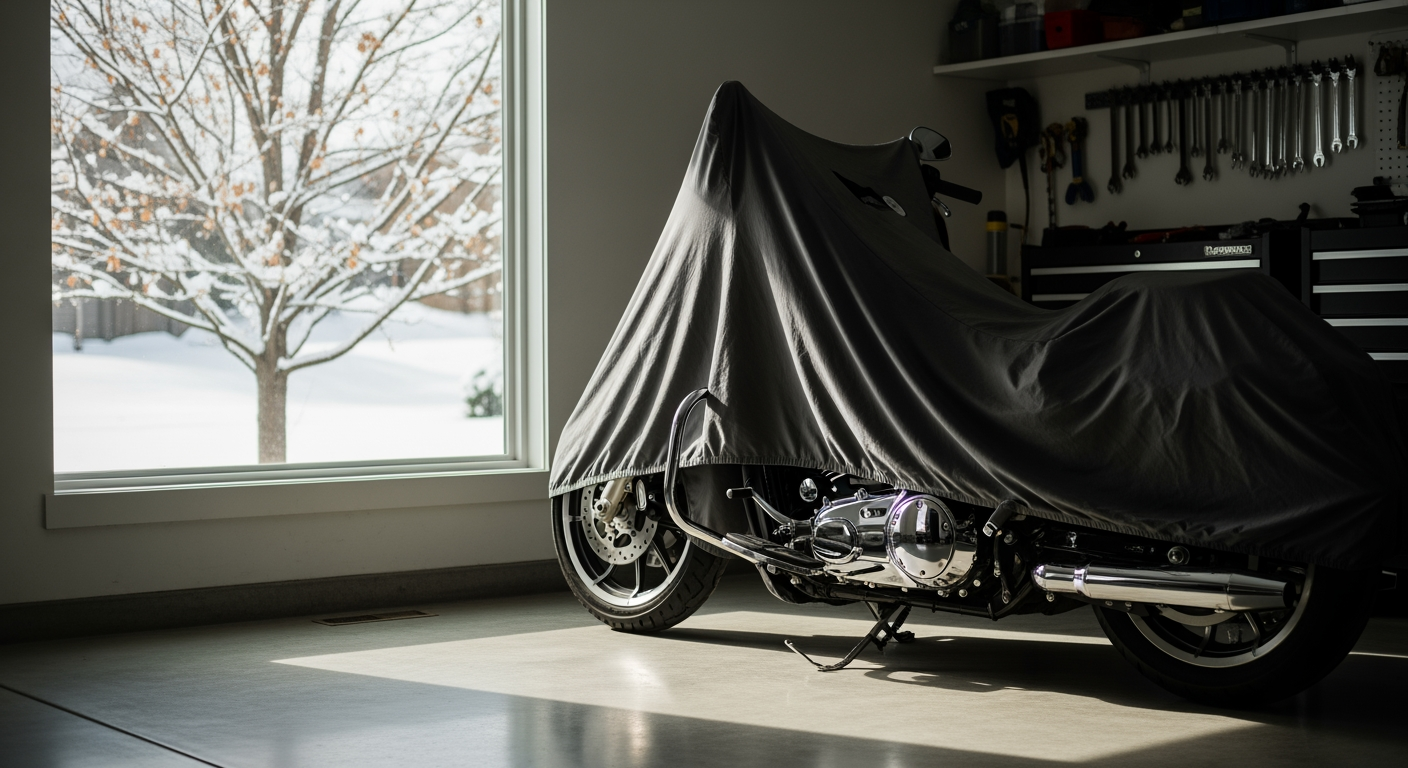
- ✓ Cover it and block the pipes. Use a breathable cover, not a plastic tarp, and stuff the exhaust with clean rags or steel wool so mice do not nest in your airbox.
Should You Keep Insurance Over the Winter?
Every fall riders ask why they should pay to insure a bike they are not riding for five months. It is a fair question, and the honest answer depends on your situation. Your bike can still be stolen or damaged while parked, and comprehensive coverage is exactly what protects it while it sits. Your uninsured and underinsured motorist protection has off-season value too, and in Illinois UM coverage is required and cannot be waived on an active auto policy. A lapse can also bump your rate when you reinstate in spring, so some riders switch to a lower storage or lay-up policy that drops liability while keeping comprehensive rather than cutting coverage off completely. Talk it through with your agent, but do not cancel on autopilot.
Re-Inspect Before Your First Spring Ride
When the salt is finally gone and the streets are dry, resist the urge to just fire it up and blast off. Check tire pressure and look for cracks or flat spots, reinstall the battery and test the lights, horn, and signals, and pull the rags or steel wool out of the exhaust before you start it. Check brakes, throttle, clutch, and cables for smooth action, and look under the bike for leaks that showed up over winter. Your reflexes are rusty too, so take the first ride slow and local before you trust the bike at speed on the Eisenhower.